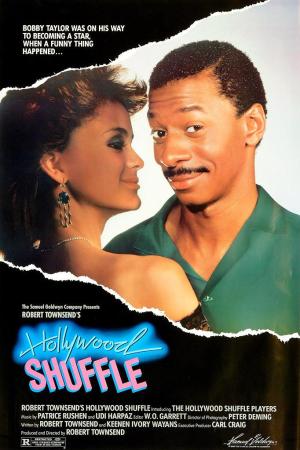
Bobby Taylor wants to be a respected actor, but he has to settle for stereotypical roles in the white-dominated world of cinema. It is clear, as he rehearses in the movie's opening scenes, that the role he is auditioning for is not exactly what he has in mind. When the movie is actually filmed, it gives the term 'Blaxploitation' a whole new meaning.
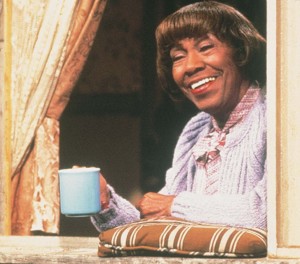
Bobby lives with his brother Stevie and his grandmother, and he is often told he could work at the post office. He does have a job at Winky Dinky Dog, a hot dog place where Donald and Tiny are his co-workers, though his auditions interfere with his ability to be on the job when needed. The most popular sitcom on TV stars a comical bat/man who isn't exactly Cliff Huxtable.
As Bobby agonizes over this role, he has fantasies about what could happen. The fantasies are the best part of the movie.
In one scene, slaves are escaping, and the one guy who worked in the house makes Stepin Fetchit look like Sidney Poitier. The same actor later turns quite sophisticated in a commercial for Black Acting School, which is taught by white instructors, where aspiring actors only learn stereotypes. Light-skinned blacks need not apply.
In another fantasy, Bobby imagines that, since Siskel and Ebert are white guys who don't know what they are talking about, his people are represented by a couple of brothers in 'Sneakin' In The Movies'. Among the characters lampooned in this fantasy are Amadeus, Indiana Jones and Dirty Harry. And there is a movie about pimps and hookers that is ten times worse than anything real.
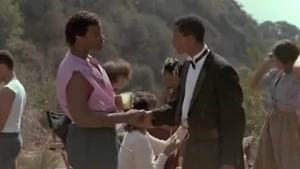
Probably the best fantasy of all happens while Bobby and his grandmother are watching 'Sam Ace', a Humphrey Bogart type movie. The film 'Death of a Breakdancer', done in black and white with the film noir style (including jazz music) stars Bobby as a black Sam Ace. While the film shows positive images, stereotypes can still be found--Jerry Curl is one of the suspects and very funny.
Rambo becomes Rambro in another scene.
Should we be enjoying all these offensive portrayals of African-Americans? Of course. Robert Townsend is black, and he produced, directed and co-wrote this movie and did a fine job of acting as well. His purpose was obviously to make fun of stereotypes. And Bobby shows that he has pride, and doesn't have to accept disrespect.
As a white person, I was not bothered by the fact that the majority of white people in this movie are portrayed in an over-the-top manner, especially the people responsible for the movie for which Bobby is auditioning. We're not like that, and I know it.
This movie was made on a budget, but one reason was the use of the same actors in many different roles. For the most part, it doesn't seem low-budget.
One of the better moments in the 'real' world takes place in the barbershop run by Bobby's Uncle Ray. David McKnight does an admirable job in a dramatic scene.
I highly recommend this movie.

 استمتع بأفلام وبرامج بلا حدود
 حمل ما تحب وشاهد بدون إنترنت
 واجهة بسيطة وأداء سلس




'%3e%3cpath%20id='Vector'%20d='M17.3996%2025.7999C17.3996%2025.9838%2017.3634%2026.1658%2017.293%2026.3357C17.2227%2026.5055%2017.1196%2026.6598%2016.9896%2026.7899C16.8596%2026.9199%2016.7052%2027.023%2016.5354%2027.0933C16.3655%2027.1637%2016.1835%2027.1999%2015.9996%2027.1999C15.8158%2027.1999%2015.6337%2027.1637%2015.4639%2027.0933C15.294%2027.023%2015.1397%2026.9199%2015.0097%2026.7899C14.8797%2026.6598%2014.7765%2026.5055%2014.7062%2026.3357C14.6358%2026.1658%2014.5996%2025.9838%2014.5996%2025.7999C14.5996%2025.4286%2014.7471%2025.0725%2015.0097%2024.81C15.2722%2024.5474%2015.6283%2024.3999%2015.9996%2024.3999C16.3709%2024.3999%2016.727%2024.5474%2016.9896%2024.81C17.2521%2025.0725%2017.3996%2025.4286%2017.3996%2025.7999Z'%20fill='white'/%3e%3cpath%20id='Union'%20fill-rule='evenodd'%20clip-rule='evenodd'%20d='M8.5%204H23.5C24.0523%204%2024.5%204.44772%2024.5%205V21.5H7.5V5C7.5%204.44772%207.94772%204%208.5%204ZM5.5%2022.5V5C5.5%203.34315%206.84315%202%208.5%202H23.5C25.1569%202%2026.5%203.34315%2026.5%205V22.5V27C26.5%2028.6569%2025.1569%2030%2023.5%2030H8.5C6.84315%2030%205.5%2028.6569%205.5%2027V22.5ZM24.5%2023.5V27C24.5%2027.5523%2024.0523%2028%2023.5%2028H8.5C7.94772%2028%207.5%2027.5523%207.5%2027V23.5H24.5Z'%20fill='white'/%3e%3cpath%20id='Union_2'%20fill-rule='evenodd'%20clip-rule='evenodd'%20d='M17%209C17%208.44772%2016.5523%208%2016%208C15.4477%208%2015%208.44772%2015%209V13.8258L13.1508%2012.2407C12.7315%2011.8813%2012.1002%2011.9299%2011.7408%2012.3492C11.3813%2012.7685%2011.4299%2013.3998%2011.8492%2013.7593L15.345%2016.7556C15.5205%2016.9079%2015.7495%2017%2016%2017C16.2506%2017%2016.4796%2016.9079%2016.6551%2016.7556L20.1508%2013.7593C20.5701%2013.3998%2020.6187%2012.7685%2020.2593%2012.3492C19.8999%2011.9299%2019.2686%2011.8813%2018.8492%2012.2407L17%2013.8258V9Z'%20fill='white'/%3e%3c/g%3e%3c/svg%3e)