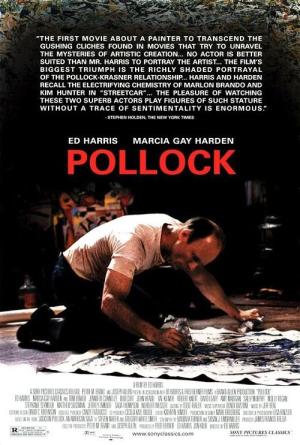
Objectively speaking, POLLOCK is not a bad film. Subjectively speaking, I hated it from the very beginning and couldn't wait for it to end. Throughout, it seems infused with the vitriolic spirit of Jackson Pollock, Stereotypical Alcoholic Artist, creating a work that is rock-hard to warm to.
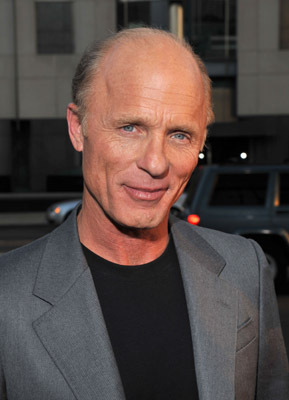
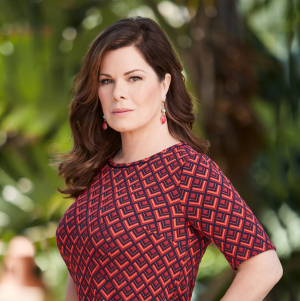
Not only is it tough to watch the sullen, surly, self-aggrandizing character played by actor-director Ed Harris, but his pushy, utterly codependent wife, Lee Krasner (Marcia Gay Harden), is another stomach-turner. `Get your own damn career and stop freeloading off his!' I found myself yelling at the screen. Put these two together and you've got the film's main focalpoint: a blatantly parasitic relationship that monotonously circles the same track, with her lowering her vast black New Yorker eyebrows in scorn and him skulking around with the loquaciousness of a two-toed sloth. Don't these characters ever get to do anything but hype his `genius,' carp and stew-for reasons we're never privy to?
Set between 1941 and Pollock's 1956 death, the film both tells too little and tells too much. It presumes knowledge of the artist's career and biography that the uninitiated don't necessarily have. For instance, several times Pollock cops a faraway look that apparently means something to cognoscenti, like, `I can see him composing I'M A DRIP #7 in his head right now.' But the gauzy gazes are never explained, and the audience strains to psych out a character who is so malicious, self-absorbed and boring that it's not worth the effort.
On the other hand, screenwriters Barbara Turner and Susan J. Emshwiller struggle to provide historical details about Pollock's shows, business dealings, interviews, etc., making the film stilted in places. They also have an unfortunate need to plug in famous quotes: `I am nature,' `I'm the only painter worth looking at in America,' etc. Using such gack-worthy lines in service of character development is a cheap form of shorthand. I guarantee we could've extrapolated that Lee thought Jack's new splatter style impressive without having her deadpan, `You've done it, Pollock. You've cracked it wide open.'
WHAT got cracked open is never revealed. There's nary a whisper of his being the first abstract expressionist, nor a mention of the designation Action Painters (though we do get to watch them guzzle beer together). The film never shares that The Dripper was fascinated with Navajo sandpaintings or the subconscious or anything else, facts that might have imbued him with some intelligence and dimension besides his supposed Neanderthal charm.
Characters fall out of the sky without any explanation of who they are or what their import. Clement Greenberg is just `Clem,'--as their farmhand might be `ol' Zeke'-forget that he was one of the era's foremost art critics. When Krasner and her bangs first appear, we have no idea if she's a critic or a painter or just some gal cruising the Village for a drunk to pop.
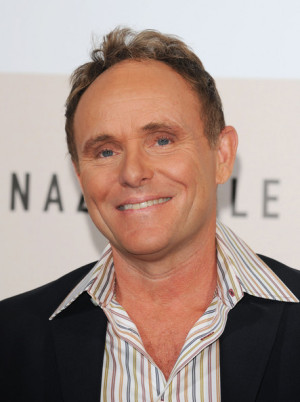
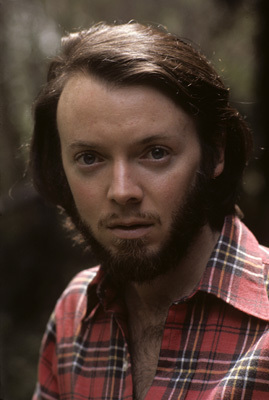
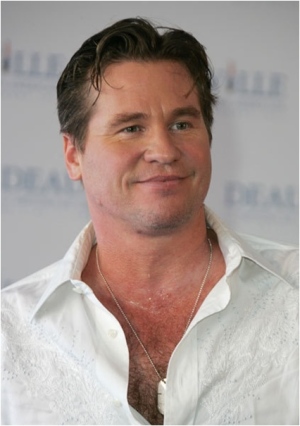
The film also jettisons the talents of several supporting actors. As Pollock's mom, Sada Thompson has sorely little to say, left to express herself with the kind of glares she used to give Buddy on FAMILY, but for reasons that are, again, never explained. Bud Cort, of HAROLD AND MAUDE fame, is a terrific surprise-but in the meagerest role on earth. And Val Kilmer's bleached-out Willem de Kooning looks as if all the sunlamps and hash bars have completely overtaken him.
Stay home and read Pollock's Pulitzer Prize-winning biography, or tip a few (paint) cans of your own.

 Mag-enjoy sa walang hanggang pelikula at palabas
 I-download ang paborito mong palabas para panoorin offline
 Simpleng disenyo at maayos na takbo




'%3e%3cpath%20id='Vector'%20d='M17.3996%2025.7999C17.3996%2025.9838%2017.3634%2026.1658%2017.293%2026.3357C17.2227%2026.5055%2017.1196%2026.6598%2016.9896%2026.7899C16.8596%2026.9199%2016.7052%2027.023%2016.5354%2027.0933C16.3655%2027.1637%2016.1835%2027.1999%2015.9996%2027.1999C15.8158%2027.1999%2015.6337%2027.1637%2015.4639%2027.0933C15.294%2027.023%2015.1397%2026.9199%2015.0097%2026.7899C14.8797%2026.6598%2014.7765%2026.5055%2014.7062%2026.3357C14.6358%2026.1658%2014.5996%2025.9838%2014.5996%2025.7999C14.5996%2025.4286%2014.7471%2025.0725%2015.0097%2024.81C15.2722%2024.5474%2015.6283%2024.3999%2015.9996%2024.3999C16.3709%2024.3999%2016.727%2024.5474%2016.9896%2024.81C17.2521%2025.0725%2017.3996%2025.4286%2017.3996%2025.7999Z'%20fill='white'/%3e%3cpath%20id='Union'%20fill-rule='evenodd'%20clip-rule='evenodd'%20d='M8.5%204H23.5C24.0523%204%2024.5%204.44772%2024.5%205V21.5H7.5V5C7.5%204.44772%207.94772%204%208.5%204ZM5.5%2022.5V5C5.5%203.34315%206.84315%202%208.5%202H23.5C25.1569%202%2026.5%203.34315%2026.5%205V22.5V27C26.5%2028.6569%2025.1569%2030%2023.5%2030H8.5C6.84315%2030%205.5%2028.6569%205.5%2027V22.5ZM24.5%2023.5V27C24.5%2027.5523%2024.0523%2028%2023.5%2028H8.5C7.94772%2028%207.5%2027.5523%207.5%2027V23.5H24.5Z'%20fill='white'/%3e%3cpath%20id='Union_2'%20fill-rule='evenodd'%20clip-rule='evenodd'%20d='M17%209C17%208.44772%2016.5523%208%2016%208C15.4477%208%2015%208.44772%2015%209V13.8258L13.1508%2012.2407C12.7315%2011.8813%2012.1002%2011.9299%2011.7408%2012.3492C11.3813%2012.7685%2011.4299%2013.3998%2011.8492%2013.7593L15.345%2016.7556C15.5205%2016.9079%2015.7495%2017%2016%2017C16.2506%2017%2016.4796%2016.9079%2016.6551%2016.7556L20.1508%2013.7593C20.5701%2013.3998%2020.6187%2012.7685%2020.2593%2012.3492C19.8999%2011.9299%2019.2686%2011.8813%2018.8492%2012.2407L17%2013.8258V9Z'%20fill='white'/%3e%3c/g%3e%3c/svg%3e)