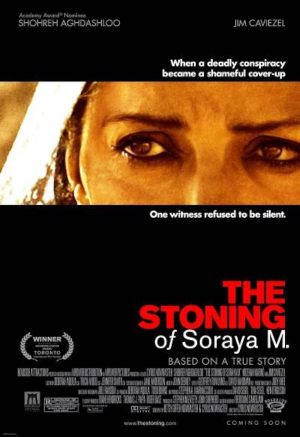
It's interesting to see a film where the majority of the reviews seem to be less about the film and more about the film's subject matter, as if they are so regaled by the subject matter that they forget to review the actual film itself.
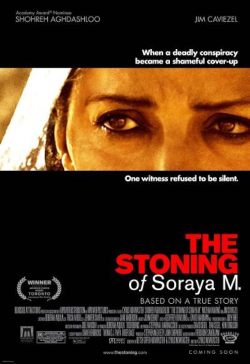
As a film, The Stoning of Soraya M is sheer exploitation. The characters are one-dimensional with motivations as simple as their dialogue, and the acting is uneven at best. Marno is convincing as a woman struggling to survive in a society in which women have been reduced to the status of chattel – although her role is so simple that she is not expected to do very much. Aghdashloo is clearly the main attraction in the film as the fiery-tongue aunt who passive-aggressively rails against an injustice of a cultural magnitude. Everyone else, on the other hand, just come across as over-the-top caricatures - clearly a failure of the script and the direction.
Soraya's stoning scene is, as expected, completely gratuitous. We know she gets stoned – it's the name of the film. In fact, in spite of all the supposed 'outrage' about the topic of 'stoning', that is what the audience is paying to see. The film uses this to its advantage by turning Soraya's stoning scene into a long and graphic torture *. It's used to climax the film and the audience, as if this kind of voyeurism is perfectly palatable if you can attach some sketchy politics to why it is shown.
And politics is what this film is really about, because it's impossible to divorce the film from the contemporary political climate of 'Islamophobia', national insecurities and infinite war justified in part through rhetoric of 'liberation' that serves as the context of its release - which is what the filmmakers are counting on. It is why so many commentators and reviewers read this film as if it was a documentary rather than a fictionalized narrative adapted from a book that was supposedly based on a second-hand account of an incident which reportedly occurred some 20 years ago.
'Stoning' has always been a controversial practice in Iran, even when it was introduced in Iran through its Islamic penal code in 1983. It has already been suspended for almost a decade by the Iranian judiciary, who are now contemplating whether the practice should be outlawed altogether. It's an issue that has generated enormous national debates, almost akin to how some deeply divisive issues, like capital punishment or abortion, are taken up in countries like the US, with some members of the clergy in Iran having spoken out to condemn the practice. Of course, this is not to imply that the current Islamic Republic is some sort of paragon of international human rights. That people can be legally punished for supposed 'moral crimes' like 'adultery', 'promiscuity', or homosexuality, should be seen as an inherent violation of humanity.
But this film does not aim to educate. It aims to entertain by sensationalizing the sight of a women buried from the waist down and used as a human piñata - something that might just as easily be a random scene in any run-of-the-mill Hollywood budget horror flick. It also aims to mobilize - and here is where it is most unethical - by appealing to a dodgy liberal sense of ethics with a dash of ignorance about modernity's 'other' that can be aligned with certain political constituencies in 'the West' that, much like the antagonists in this film, already place differential values on human life by their very actions and words.

 Profitez de films et séries sans limite
 Téléchargez vos contenus favoris pour regarder hors ligne
 Interface simple et utilisation fluide




'%3e%3cpath%20id='Vector'%20d='M17.3996%2025.7999C17.3996%2025.9838%2017.3634%2026.1658%2017.293%2026.3357C17.2227%2026.5055%2017.1196%2026.6598%2016.9896%2026.7899C16.8596%2026.9199%2016.7052%2027.023%2016.5354%2027.0933C16.3655%2027.1637%2016.1835%2027.1999%2015.9996%2027.1999C15.8158%2027.1999%2015.6337%2027.1637%2015.4639%2027.0933C15.294%2027.023%2015.1397%2026.9199%2015.0097%2026.7899C14.8797%2026.6598%2014.7765%2026.5055%2014.7062%2026.3357C14.6358%2026.1658%2014.5996%2025.9838%2014.5996%2025.7999C14.5996%2025.4286%2014.7471%2025.0725%2015.0097%2024.81C15.2722%2024.5474%2015.6283%2024.3999%2015.9996%2024.3999C16.3709%2024.3999%2016.727%2024.5474%2016.9896%2024.81C17.2521%2025.0725%2017.3996%2025.4286%2017.3996%2025.7999Z'%20fill='white'/%3e%3cpath%20id='Union'%20fill-rule='evenodd'%20clip-rule='evenodd'%20d='M8.5%204H23.5C24.0523%204%2024.5%204.44772%2024.5%205V21.5H7.5V5C7.5%204.44772%207.94772%204%208.5%204ZM5.5%2022.5V5C5.5%203.34315%206.84315%202%208.5%202H23.5C25.1569%202%2026.5%203.34315%2026.5%205V22.5V27C26.5%2028.6569%2025.1569%2030%2023.5%2030H8.5C6.84315%2030%205.5%2028.6569%205.5%2027V22.5ZM24.5%2023.5V27C24.5%2027.5523%2024.0523%2028%2023.5%2028H8.5C7.94772%2028%207.5%2027.5523%207.5%2027V23.5H24.5Z'%20fill='white'/%3e%3cpath%20id='Union_2'%20fill-rule='evenodd'%20clip-rule='evenodd'%20d='M17%209C17%208.44772%2016.5523%208%2016%208C15.4477%208%2015%208.44772%2015%209V13.8258L13.1508%2012.2407C12.7315%2011.8813%2012.1002%2011.9299%2011.7408%2012.3492C11.3813%2012.7685%2011.4299%2013.3998%2011.8492%2013.7593L15.345%2016.7556C15.5205%2016.9079%2015.7495%2017%2016%2017C16.2506%2017%2016.4796%2016.9079%2016.6551%2016.7556L20.1508%2013.7593C20.5701%2013.3998%2020.6187%2012.7685%2020.2593%2012.3492C19.8999%2011.9299%2019.2686%2011.8813%2018.8492%2012.2407L17%2013.8258V9Z'%20fill='white'/%3e%3c/g%3e%3c/svg%3e)