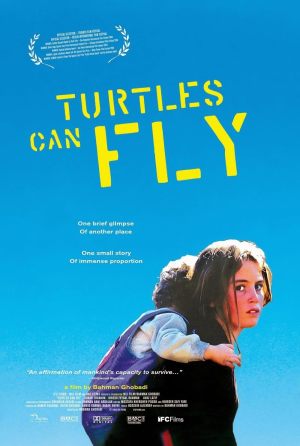
A chronicle of the hardships visited upon Kurdish children in a refugee camp near the Turkish border during the war against Saddam, as well as an account, to some extent, of those they visit upon each other, "Turtles Can Fly" is undeniably the work of a cinematic master. Just about every frame - whether of bleak, oddly beautiful landscape or of anguished or amused faces which speak volumes - ties one's eyes to the screen. Similarly, scenes of horror - the rape of the character Agrin or the young Kurdish leader Satellite's effort to save a blind child from a land mine - are pretty nearly unbearable in their dramatic intensity. Also, the director/writer is happily unjaded enough to conceive of characters, in this case children, who are capable of fertile and generous emotion without himself tumbling into patently false representations. In this regard, the armless brother Henkov's love for Agrin's child or the loyalty of one of Satellite's tiniest followers especially stand out. Yet all in all this film is oddly unsatisfying, and the problem, I suspect, has to do with the director/writer's judgment and consequently skewed focus. Concentrating on the mere phenomenology of war and the sufferings of children in it, Gohbadi pretty much dismisses larger causes or courses, so that his vision is reduced to that of TV news. In other words, any war is hell, as images of dismemberment make clear, and all sides are equally culpable because of the havoc and suffering war wreaks on private life. This is an age old and surely possible donee, and when handled with subtlety and depth as it was, say, in Euripides' "Trojan Women," it's beyond reproach. In Ghobadi's film, however, we appear to wind up with the peevish, overly simple, indeed Princess Diana-like judgment that the greatest cause of evil in the lives of displaced Kurdish children is remnant land mines. The mountains rumble, and all that's produced, unfortunately, is this ridiculous mouse.

 Profitez de films et séries sans limite
 Téléchargez vos contenus favoris pour regarder hors ligne
 Interface simple et utilisation fluide




'%3e%3cpath%20id='Vector'%20d='M17.3996%2025.7999C17.3996%2025.9838%2017.3634%2026.1658%2017.293%2026.3357C17.2227%2026.5055%2017.1196%2026.6598%2016.9896%2026.7899C16.8596%2026.9199%2016.7052%2027.023%2016.5354%2027.0933C16.3655%2027.1637%2016.1835%2027.1999%2015.9996%2027.1999C15.8158%2027.1999%2015.6337%2027.1637%2015.4639%2027.0933C15.294%2027.023%2015.1397%2026.9199%2015.0097%2026.7899C14.8797%2026.6598%2014.7765%2026.5055%2014.7062%2026.3357C14.6358%2026.1658%2014.5996%2025.9838%2014.5996%2025.7999C14.5996%2025.4286%2014.7471%2025.0725%2015.0097%2024.81C15.2722%2024.5474%2015.6283%2024.3999%2015.9996%2024.3999C16.3709%2024.3999%2016.727%2024.5474%2016.9896%2024.81C17.2521%2025.0725%2017.3996%2025.4286%2017.3996%2025.7999Z'%20fill='white'/%3e%3cpath%20id='Union'%20fill-rule='evenodd'%20clip-rule='evenodd'%20d='M8.5%204H23.5C24.0523%204%2024.5%204.44772%2024.5%205V21.5H7.5V5C7.5%204.44772%207.94772%204%208.5%204ZM5.5%2022.5V5C5.5%203.34315%206.84315%202%208.5%202H23.5C25.1569%202%2026.5%203.34315%2026.5%205V22.5V27C26.5%2028.6569%2025.1569%2030%2023.5%2030H8.5C6.84315%2030%205.5%2028.6569%205.5%2027V22.5ZM24.5%2023.5V27C24.5%2027.5523%2024.0523%2028%2023.5%2028H8.5C7.94772%2028%207.5%2027.5523%207.5%2027V23.5H24.5Z'%20fill='white'/%3e%3cpath%20id='Union_2'%20fill-rule='evenodd'%20clip-rule='evenodd'%20d='M17%209C17%208.44772%2016.5523%208%2016%208C15.4477%208%2015%208.44772%2015%209V13.8258L13.1508%2012.2407C12.7315%2011.8813%2012.1002%2011.9299%2011.7408%2012.3492C11.3813%2012.7685%2011.4299%2013.3998%2011.8492%2013.7593L15.345%2016.7556C15.5205%2016.9079%2015.7495%2017%2016%2017C16.2506%2017%2016.4796%2016.9079%2016.6551%2016.7556L20.1508%2013.7593C20.5701%2013.3998%2020.6187%2012.7685%2020.2593%2012.3492C19.8999%2011.9299%2019.2686%2011.8813%2018.8492%2012.2407L17%2013.8258V9Z'%20fill='white'/%3e%3c/g%3e%3c/svg%3e)