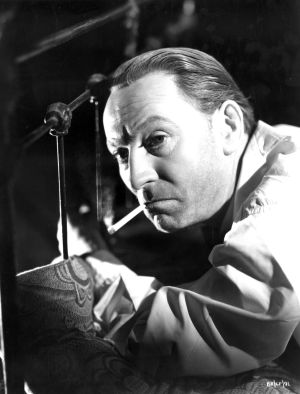
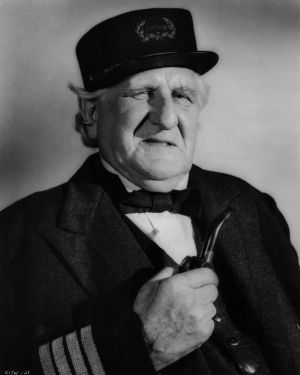
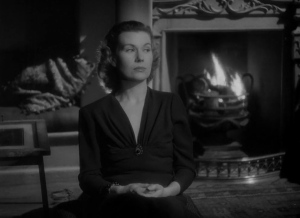
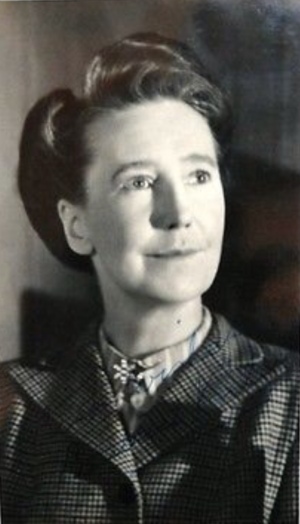
This must be the only time that Tommy Trinder -- or any other performer, surely? -- got lead billing in a vehicle written for him in his comic capacity, only to end up unexpectedly killed off before the finish of the film...
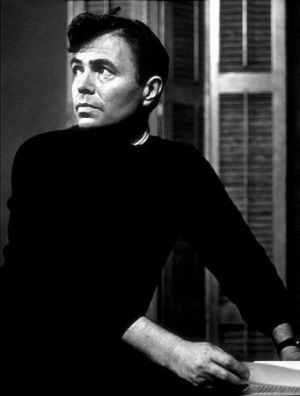
That said, the lead billing of Trinder is misleading: in actual fact "The Bells Go Down" is very much an ensemble piece with principal narrative strands centred around James Mason and Philip Friend, plus the standard theme of the welding together of a disparate team. Tommy Trinder's role in the film is that of intermittent comic relief, which unfortunately tends to jar more and more as the subject matter becomes more serious.
At the beginning, with its light-hearted tone, his breezy persona fits seamlessly into the action and is often very funny; but as the characters are launched into the East End Blitz with, for example, Bob faced with an order to destroy his own home to save the warehouses opposite for the war effort, the character of Tommy acquires no extra depth and is in consequence sidelined to the occasional chirpy interlude. It is perhaps symptomatic that the whole 'Short Head' plot strand rather fizzles out, the greyhound's importance totally overwhelmed in the minds of both characters and audience by the intervening nights of battle against the flames.
The result is that Tommy Turk's death comes as a shock, but not quite of the nature intended: the narrative to date simply hasn't telegraphed the character as being that important. Certainly his actions are not inconsistent with the character established, and Trinder plays the scene well. (He was apparently so proud of this performance that he kept blatantly plugging it in his stage act, leading one heckler to retort that he'd rather watch the comedian 'die' on stage at the Palladium!) But the film then suddenly swings into po-faced, full blown 'fallen hero' mode -- better perhaps to have handled it via the shocked reactions of the survivors outside the building at the time? -- and actually managed to leave me confused for some minutes as to what in fact had just happened. It scarcely seems an apt memorial to a character who spends most of the film cheerfully sneaking a surreptitious fag, and rather unbalances the picture just at the ending.
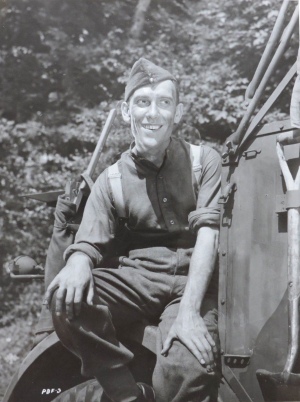
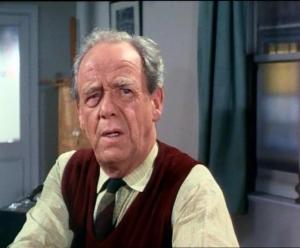
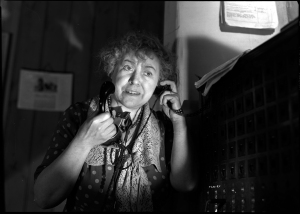
William Hartnell, here billed as 'Billy Hartnell', provides, as so often, convincing and capable support as Brookes, the intellectual (and presumably left-winger) of the brigade, who has seen the horrors of the Spanish Civil War. Mervyn Johns, as the petty crook Sam, has a similar comic-relief role to Trinder's but is integrated better into the team, while Richard George as his nemesis, the Irish P.C. O'Brien, is inevitably somewhat one-dimensional, but the two have a good scene together at the height of the Blitz which is nicely understated and effective. Muriel George outshines both the younger women as Ted's formidable mother.
The special effects for the numerous fire scenes are seamless and very realistic (or perhaps they really did put the sets alight!) and an extensive selection of Fire Service equipment was clearly made available to the studio. The film starts off in classic Ealing style as a snapshot of a community, and remains both sure-footed in comedy territory and quietly powerful in certain more serious scenes. But one suspects that more concern was paid to the drawing-power of Tommy Trinder's name than to how his talents would be fitted into the film, and it suffers from what I felt was a badly handled and somewhat glib conclusion.

 Nikmati film dan acara tanpa batas
 Download konten favorit untuk ditonton offline
 Tampilan mudah, lancar dipakai




'%3e%3cpath%20id='Vector'%20d='M17.3996%2025.7999C17.3996%2025.9838%2017.3634%2026.1658%2017.293%2026.3357C17.2227%2026.5055%2017.1196%2026.6598%2016.9896%2026.7899C16.8596%2026.9199%2016.7052%2027.023%2016.5354%2027.0933C16.3655%2027.1637%2016.1835%2027.1999%2015.9996%2027.1999C15.8158%2027.1999%2015.6337%2027.1637%2015.4639%2027.0933C15.294%2027.023%2015.1397%2026.9199%2015.0097%2026.7899C14.8797%2026.6598%2014.7765%2026.5055%2014.7062%2026.3357C14.6358%2026.1658%2014.5996%2025.9838%2014.5996%2025.7999C14.5996%2025.4286%2014.7471%2025.0725%2015.0097%2024.81C15.2722%2024.5474%2015.6283%2024.3999%2015.9996%2024.3999C16.3709%2024.3999%2016.727%2024.5474%2016.9896%2024.81C17.2521%2025.0725%2017.3996%2025.4286%2017.3996%2025.7999Z'%20fill='white'/%3e%3cpath%20id='Union'%20fill-rule='evenodd'%20clip-rule='evenodd'%20d='M8.5%204H23.5C24.0523%204%2024.5%204.44772%2024.5%205V21.5H7.5V5C7.5%204.44772%207.94772%204%208.5%204ZM5.5%2022.5V5C5.5%203.34315%206.84315%202%208.5%202H23.5C25.1569%202%2026.5%203.34315%2026.5%205V22.5V27C26.5%2028.6569%2025.1569%2030%2023.5%2030H8.5C6.84315%2030%205.5%2028.6569%205.5%2027V22.5ZM24.5%2023.5V27C24.5%2027.5523%2024.0523%2028%2023.5%2028H8.5C7.94772%2028%207.5%2027.5523%207.5%2027V23.5H24.5Z'%20fill='white'/%3e%3cpath%20id='Union_2'%20fill-rule='evenodd'%20clip-rule='evenodd'%20d='M17%209C17%208.44772%2016.5523%208%2016%208C15.4477%208%2015%208.44772%2015%209V13.8258L13.1508%2012.2407C12.7315%2011.8813%2012.1002%2011.9299%2011.7408%2012.3492C11.3813%2012.7685%2011.4299%2013.3998%2011.8492%2013.7593L15.345%2016.7556C15.5205%2016.9079%2015.7495%2017%2016%2017C16.2506%2017%2016.4796%2016.9079%2016.6551%2016.7556L20.1508%2013.7593C20.5701%2013.3998%2020.6187%2012.7685%2020.2593%2012.3492C19.8999%2011.9299%2019.2686%2011.8813%2018.8492%2012.2407L17%2013.8258V9Z'%20fill='white'/%3e%3c/g%3e%3c/svg%3e)