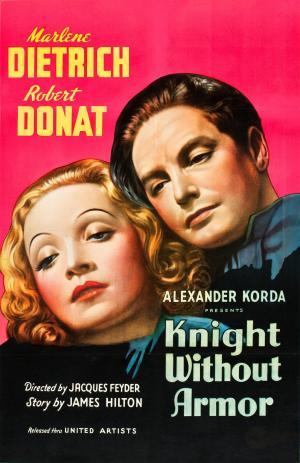
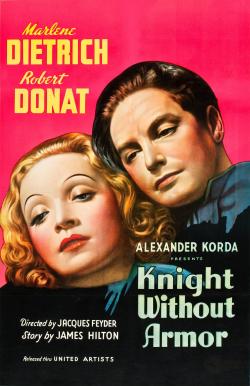
Casting Marlene Dietrich (a coup achieved only after Donat's own two preferred actresses proved unavailable -- he was supposed to have the right of veto on the leading lady) may have been a publicity coup for Alexander Korda, but to be honest I'm not sure it did the film any favours.
With Dietrich on board and then Donat so ill the start of the film had to be shot around him, the part of the Russian Countess was massively pumped-up, causing the running time to go seriously over-length. Supposedly about two hours of material then had to be cut out, a process which is most evident towards the beginning of the film where passing time is skated over very unevenly.
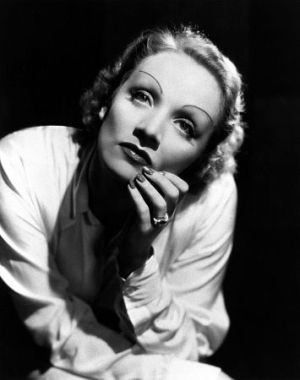
Secondly, scenes featuring Dietrich have a tendency to feature long, loving close-ups of her face at the expense of pacing, plausibility (her make-up never falters) and acting -- Donat's own close-ups are reaction shots in which we see a shadow of significant emotion or realisation, but Dietrich's might as well be promotional stills for all the expression she gets to demonstrate. (Ironically she also comes across as too worldly and sophisticated for the part, certainly in the opening scenes: I had her pegged as an unmarried daughter/companion in her twenties from her racetrack appearance, and was jolted to subsequently find that the character was supposed to be a teenage débutante!) Dietrich was far better in her earlier Russian role of "The Scarlet Empress", Catherine the Great: here she is little more than a doll to be pushed around and emerge in an improbable china glow.
It is perhaps because of this that I can't see any real chemistry between the two characters: Donat shows chivalry and protectiveness throughout, but his subsequent protestations of love (and her requisite responses) felt to me very arbitrary and artificial. A sudden excess of calling one another 'darling' and kissing are not the same thing as demonstrating any actual feeling between the characters, unfortunately, and the script feels forced in this respect.
Where the film does shine -- or at least engross - is in its depiction of the scrambling post-revolutionary war of brutality and counter-brutality, and the hordes of hapless refugees caught up between the two. There are a lot of executions in this film; then just when the audience is keyed up for another, the hero makes his escape (courtesy of an unexpectedly schoolboy knockdown blow) and the others scheduled for execution take advantage of the confusion to attempt to turn the tables. Subconsciously I suppose we expect a morally uplifting outcome, which makes the brutal bayoneting that follows all the more shocking.
As others have said, the scene where the Countess wakes up to find her entire house deserted -- save for one peasant woman at the riverside who flees at the sight of her -- is a powerful one, as is the moment when she faces down the mob... unsuccessfully. I did find the big reveal of the line of soldiers suddenly coming over the brow all around the horizon to be a little too cinematic for its own good, though: shades of Westerns throughout the ages, in a scene that's more "Tale of Two Cities". (My other problem with this scene is that, again, Dietrich displays almost no emotion of any kind and just stands there in soft-focus looking blankly beautiful.)
Sections of this film are very good, but they are mostly not the sections featuring the character of the Countess; and certainly not those using her as a glamour object, which tend to be rather banal. I can't help suspecting that what I'm seeing is the bones of the original novel showing through the star overlay.

 Enjoy unlimited movies and shows
 Download your favorite content to watch offline
 Simple interface & smooth performance
















'%3e%3cpath%20id='Vector'%20d='M17.3996%2025.7999C17.3996%2025.9838%2017.3634%2026.1658%2017.293%2026.3357C17.2227%2026.5055%2017.1196%2026.6598%2016.9896%2026.7899C16.8596%2026.9199%2016.7052%2027.023%2016.5354%2027.0933C16.3655%2027.1637%2016.1835%2027.1999%2015.9996%2027.1999C15.8158%2027.1999%2015.6337%2027.1637%2015.4639%2027.0933C15.294%2027.023%2015.1397%2026.9199%2015.0097%2026.7899C14.8797%2026.6598%2014.7765%2026.5055%2014.7062%2026.3357C14.6358%2026.1658%2014.5996%2025.9838%2014.5996%2025.7999C14.5996%2025.4286%2014.7471%2025.0725%2015.0097%2024.81C15.2722%2024.5474%2015.6283%2024.3999%2015.9996%2024.3999C16.3709%2024.3999%2016.727%2024.5474%2016.9896%2024.81C17.2521%2025.0725%2017.3996%2025.4286%2017.3996%2025.7999Z'%20fill='white'/%3e%3cpath%20id='Union'%20fill-rule='evenodd'%20clip-rule='evenodd'%20d='M8.5%204H23.5C24.0523%204%2024.5%204.44772%2024.5%205V21.5H7.5V5C7.5%204.44772%207.94772%204%208.5%204ZM5.5%2022.5V5C5.5%203.34315%206.84315%202%208.5%202H23.5C25.1569%202%2026.5%203.34315%2026.5%205V22.5V27C26.5%2028.6569%2025.1569%2030%2023.5%2030H8.5C6.84315%2030%205.5%2028.6569%205.5%2027V22.5ZM24.5%2023.5V27C24.5%2027.5523%2024.0523%2028%2023.5%2028H8.5C7.94772%2028%207.5%2027.5523%207.5%2027V23.5H24.5Z'%20fill='white'/%3e%3cpath%20id='Union_2'%20fill-rule='evenodd'%20clip-rule='evenodd'%20d='M17%209C17%208.44772%2016.5523%208%2016%208C15.4477%208%2015%208.44772%2015%209V13.8258L13.1508%2012.2407C12.7315%2011.8813%2012.1002%2011.9299%2011.7408%2012.3492C11.3813%2012.7685%2011.4299%2013.3998%2011.8492%2013.7593L15.345%2016.7556C15.5205%2016.9079%2015.7495%2017%2016%2017C16.2506%2017%2016.4796%2016.9079%2016.6551%2016.7556L20.1508%2013.7593C20.5701%2013.3998%2020.6187%2012.7685%2020.2593%2012.3492C19.8999%2011.9299%2019.2686%2011.8813%2018.8492%2012.2407L17%2013.8258V9Z'%20fill='white'/%3e%3c/g%3e%3c/svg%3e)
