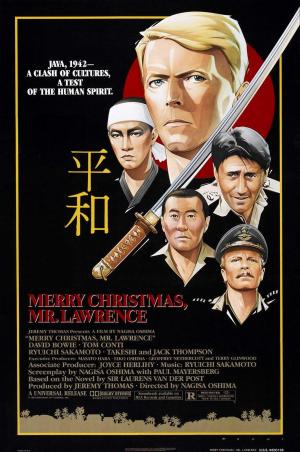
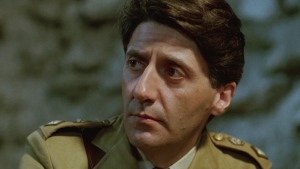
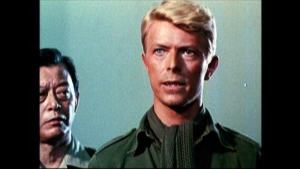
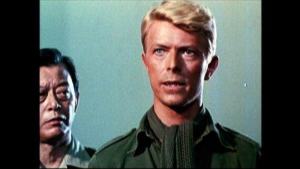
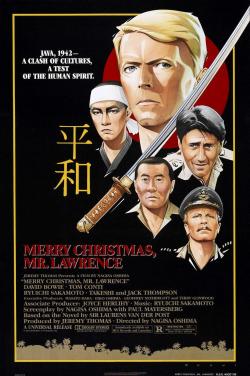
I finally watched this yesterday and I am going to go out on a limb and register my disappointment with the film. When you look back on a film made when Bowie was at his peak, you have to consider his star power in being cast in a Japanese film. He is a fine actor and his work, small in number, is good enough to consider watching in other films. I feel that he was miscast for this film or put another way round, was cast because he was the blue eyed wonder boy from British pop. I mean, a English pop star in the same film as a Japanese pop star? Flags should have gone up on that. In Bowie's defence, he's not given a lot of latitude to move around in his role or much in the way of dialogue. He is used to glare at the camera a lot or else munch on flowers in a grotesque scene that, if important, passes over our heads. Conti is an excellent actor but what drove me nuts was his smirk or smile or fawning good humour with his Japanese tormentors, who were regularly killing soldiers. It made very little sense in the context of what camp life was really like for POW's.
The flashback scenes to Cellier's childhood made little sense. What are we to make of this other than he has feelings of guilt, for having been such a cold hearted jack ass to his kid brother? So what are we to make of this guilt? It is not developed in a direct and full manner in the film. I mean, if you want to coat the film with Shakespearean drama, then do something with the guilt. Nothing; and so, it makes little sense.
Which leads me to a deeper sense of disappointment. I might be dead wrong, but I had the sense throughout the whole film that the really shocking horrors of what the Japanese really did to prisoners were bleached a bit, sanitized to make the film more palatable to the Japanese market. It is fairly well known that the Japanese to this date have not dealt with their war crimes in a full face on mea culpa. Not even close to the soul cleansing that the German people have done and seen in their movies and literature. Go and ask the South Koreans, Chinese or Vietnamese what they think of the Japanese, especially about their war crimes and you'll get a totally different perspective than this film shows. I mean, it is not that Japanese films cannot be bloodily and bluntly honest. Most of Kurosawa's films are unsentimental, brutal and fearless in depicting the savagery of the Japanese warrior.
Consider then, what this topic would look like if made by a British director, who might have known Brits who survived a Japanese concentration camp? I dare say that the drama would not have been so ambiguous, teetering as it does several times, on the travails of a camp commander as he has his Shakespearean moments of doubt. I was so sick and tired of the commandants pouting facial gestures and his childish tirades. If you really want a taste of what these camps were like then forget about this rather silly film. Read the book "Unbroken". It is a stupendous book on all levels and it covers the survival of a man in the midst of the most brutal, savage and bestial actions, that take place in a Japanese POW camp. That is the real heart of darkness and it is watered down in this film. I was not impressed. "The Bridge over the River Kwai" is far superior. This film should be remade and not by a Japanese director, with all due respects to some of their excellent cinema.

 Enjoy unlimited movies and shows
 Download your favorite content to watch offline
 Simple interface & smooth performance

















'%3e%3cpath%20id='Vector'%20d='M17.3996%2025.7999C17.3996%2025.9838%2017.3634%2026.1658%2017.293%2026.3357C17.2227%2026.5055%2017.1196%2026.6598%2016.9896%2026.7899C16.8596%2026.9199%2016.7052%2027.023%2016.5354%2027.0933C16.3655%2027.1637%2016.1835%2027.1999%2015.9996%2027.1999C15.8158%2027.1999%2015.6337%2027.1637%2015.4639%2027.0933C15.294%2027.023%2015.1397%2026.9199%2015.0097%2026.7899C14.8797%2026.6598%2014.7765%2026.5055%2014.7062%2026.3357C14.6358%2026.1658%2014.5996%2025.9838%2014.5996%2025.7999C14.5996%2025.4286%2014.7471%2025.0725%2015.0097%2024.81C15.2722%2024.5474%2015.6283%2024.3999%2015.9996%2024.3999C16.3709%2024.3999%2016.727%2024.5474%2016.9896%2024.81C17.2521%2025.0725%2017.3996%2025.4286%2017.3996%2025.7999Z'%20fill='white'/%3e%3cpath%20id='Union'%20fill-rule='evenodd'%20clip-rule='evenodd'%20d='M8.5%204H23.5C24.0523%204%2024.5%204.44772%2024.5%205V21.5H7.5V5C7.5%204.44772%207.94772%204%208.5%204ZM5.5%2022.5V5C5.5%203.34315%206.84315%202%208.5%202H23.5C25.1569%202%2026.5%203.34315%2026.5%205V22.5V27C26.5%2028.6569%2025.1569%2030%2023.5%2030H8.5C6.84315%2030%205.5%2028.6569%205.5%2027V22.5ZM24.5%2023.5V27C24.5%2027.5523%2024.0523%2028%2023.5%2028H8.5C7.94772%2028%207.5%2027.5523%207.5%2027V23.5H24.5Z'%20fill='white'/%3e%3cpath%20id='Union_2'%20fill-rule='evenodd'%20clip-rule='evenodd'%20d='M17%209C17%208.44772%2016.5523%208%2016%208C15.4477%208%2015%208.44772%2015%209V13.8258L13.1508%2012.2407C12.7315%2011.8813%2012.1002%2011.9299%2011.7408%2012.3492C11.3813%2012.7685%2011.4299%2013.3998%2011.8492%2013.7593L15.345%2016.7556C15.5205%2016.9079%2015.7495%2017%2016%2017C16.2506%2017%2016.4796%2016.9079%2016.6551%2016.7556L20.1508%2013.7593C20.5701%2013.3998%2020.6187%2012.7685%2020.2593%2012.3492C19.8999%2011.9299%2019.2686%2011.8813%2018.8492%2012.2407L17%2013.8258V9Z'%20fill='white'/%3e%3c/g%3e%3c/svg%3e)
