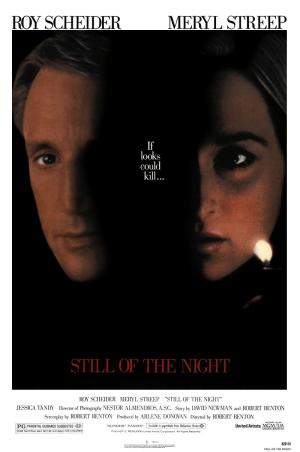
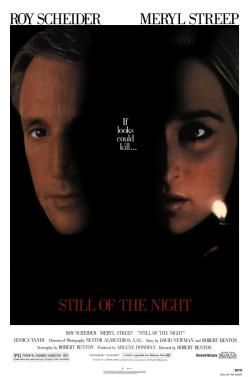
Still of the Night is a mood picture, in the purest and simplest way. It can almost be said that it's a meditation on a full moon. It begins and ends with a long, still take of one. Both times are the only times the film is scored with music. The story is not a series of situations being vocalized and handled in the physical world. It's about things dawning on a character, that character's feelings being stirred and reacting to events that take place around him, or in the past.
We don't get to the bottom of everything until he does, and to the extent he does. Gradually, he understands a woman about whom he only knows so much, and throughout is uncertain of how to feel about her. Indeed, it's a film so carefully measured, so understated that if the story of a scene can be told with no words, then we will hear no words. In this way, it's pure cinema. It's a flow of sequences that build a dark, quiet stairway of tension, yet they're also thoroughly self-contained because they're so finely and fully attuned to setting, atmosphere and the inside and outside of every character in these very moments.
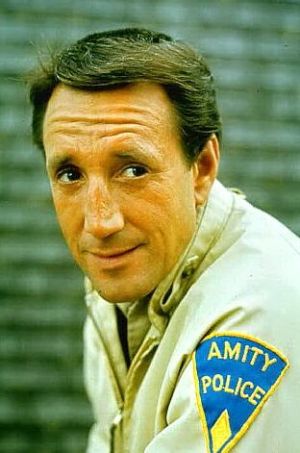
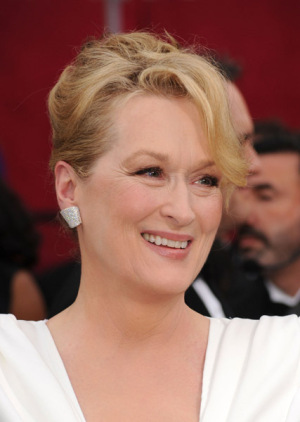
Roy Scheider is so masculine and intense and yet he is so mild-mannered and tenderly human in these beautiful surroundings, but it is the object of his experiences here, Meryl Streep, who fits in to the universe of the film with a profound naturalism as a sort of mirror image of it. Just as the film cycles to and fro between the beautiful mundanities of the present tense and the amber antiquity of the past so seamlessly owing to the stream of consciousness interconnecting these scenes, Streep, having so fully internalized through Kramer vs. Kramer and Sophie's Choice the persona of a woman who can't escape her bondage with her past, brings that same energy here with such naturalism that she evokes it in a performance so minimal in what she says or how much she betrays at all. And when she does, it's a film climax equal to any special effect, gun fight, chase or struggle.
A crucial aspect of how Robert Benton fashions an atmosphere as real, certain and arresting as one of the wood furnishings in the murder victim's flashback scenes is how barely he employs music score. His choice to use it when he does is as emotively precise as when the score is sound itself, murmurs, humming washing cycles, strange sporadic thumps coming from the shadows, all cadenced to create tension in their own deliberate ways. Benton again substantiates that delicacy and understatement are his forte. It comes as practically a kick in the teeth to see a modern suspense picture as erudite, well acted and exquisitely made as Still Of The Night.

 Enjoy unlimited movies and shows
 Download your favorite content to watch offline
 Simple interface & smooth performance















'%3e%3cpath%20id='Vector'%20d='M17.3996%2025.7999C17.3996%2025.9838%2017.3634%2026.1658%2017.293%2026.3357C17.2227%2026.5055%2017.1196%2026.6598%2016.9896%2026.7899C16.8596%2026.9199%2016.7052%2027.023%2016.5354%2027.0933C16.3655%2027.1637%2016.1835%2027.1999%2015.9996%2027.1999C15.8158%2027.1999%2015.6337%2027.1637%2015.4639%2027.0933C15.294%2027.023%2015.1397%2026.9199%2015.0097%2026.7899C14.8797%2026.6598%2014.7765%2026.5055%2014.7062%2026.3357C14.6358%2026.1658%2014.5996%2025.9838%2014.5996%2025.7999C14.5996%2025.4286%2014.7471%2025.0725%2015.0097%2024.81C15.2722%2024.5474%2015.6283%2024.3999%2015.9996%2024.3999C16.3709%2024.3999%2016.727%2024.5474%2016.9896%2024.81C17.2521%2025.0725%2017.3996%2025.4286%2017.3996%2025.7999Z'%20fill='white'/%3e%3cpath%20id='Union'%20fill-rule='evenodd'%20clip-rule='evenodd'%20d='M8.5%204H23.5C24.0523%204%2024.5%204.44772%2024.5%205V21.5H7.5V5C7.5%204.44772%207.94772%204%208.5%204ZM5.5%2022.5V5C5.5%203.34315%206.84315%202%208.5%202H23.5C25.1569%202%2026.5%203.34315%2026.5%205V22.5V27C26.5%2028.6569%2025.1569%2030%2023.5%2030H8.5C6.84315%2030%205.5%2028.6569%205.5%2027V22.5ZM24.5%2023.5V27C24.5%2027.5523%2024.0523%2028%2023.5%2028H8.5C7.94772%2028%207.5%2027.5523%207.5%2027V23.5H24.5Z'%20fill='white'/%3e%3cpath%20id='Union_2'%20fill-rule='evenodd'%20clip-rule='evenodd'%20d='M17%209C17%208.44772%2016.5523%208%2016%208C15.4477%208%2015%208.44772%2015%209V13.8258L13.1508%2012.2407C12.7315%2011.8813%2012.1002%2011.9299%2011.7408%2012.3492C11.3813%2012.7685%2011.4299%2013.3998%2011.8492%2013.7593L15.345%2016.7556C15.5205%2016.9079%2015.7495%2017%2016%2017C16.2506%2017%2016.4796%2016.9079%2016.6551%2016.7556L20.1508%2013.7593C20.5701%2013.3998%2020.6187%2012.7685%2020.2593%2012.3492C19.8999%2011.9299%2019.2686%2011.8813%2018.8492%2012.2407L17%2013.8258V9Z'%20fill='white'/%3e%3c/g%3e%3c/svg%3e)
