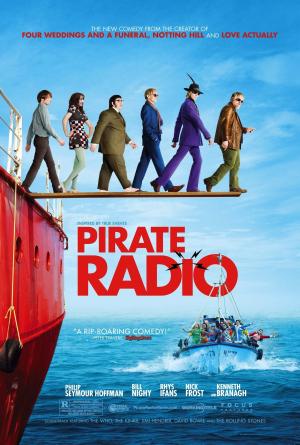
This is Richard Curtis's love-letter to the pirate radio ships that did so much to promote pop and rock music in the UK in the mid-60's, under the noses of the Establishment before being outlawed by the government in 1967 with the creation of the pop-oriented BBC Radio 1. I'm just a little too young to be aware of the impact of the pirates at the time although I've heard the odd nostalgic radio documentary retelling the story and to be absolutely honest, that medium probably served the story better as the subject does not justify a two hour plus movie like this.
Actually the more I think about it, with its obvious references to the actual disc-jockeys (who all washed away their rebellious principles by signing up to the BBC en-masse and thus became familiar to the wider public, yours truly included), you have to wonder about the moral compass of a movie that lionises anodyne jocks like Tony Blackburn, Dave Lee Travis, Bob Harris, Stuart Henry and others. Even the inclusion of a miscast Philip Seymour-Hoffman revisiting, presumably, American renegade Emperor Rosko doesn't help the movie float (sorry) and a mock-grandiose conclusion, where yet again Curtis rallies all his cast and a horde of extras for the grandstand finish, only heightens the shortcomings.
Women are treated as mere chattels, fame-obsessed fans desperate to sleep with their medium-wave heroes at the drop of a light-switch, but of course being politically correct a token black guy finds himself on board, alongside a lesbian tea-maid, who even manages to score with a pretty lesbian fan herself.
The comedic scenes are telegraphed in from Carry On Doctor At Sea, plus I doubt a four-letter word was ever broadcast on-air as is made out here. Even the music is all over the place, many of the songs actually hailing from 1968, ("Jumping Jack Flash", "Fire" for example, while The Who's "Won't Get Fooled Again" is from 1971) the year after the pirates closed down, while the lack of any songs by The Beatles, the major movers of the times has to be a mistake too. The only thing that made me smile was the Python-like recreation of Jimi Hendrix's notorious "Electric Ladyland" album-sleeve (again from 1968 however, pop-pickers!), albeit with a bevy of naked women in tow.
In fact the best and most rebellious thing about the film was the soundtrack, a reminder of just how tumultuously wonderful the British music scene was at the time. Buy the soundtrack album if there is one and leave this tame comedic romp at the bottom of the sea where the pirate ship eventually settles by the end.

 Enjoy unlimited movies and shows
 Download your favorite content to watch offline
 Simple interface & smooth performance




'%3e%3cpath%20id='Vector'%20d='M17.3996%2025.7999C17.3996%2025.9838%2017.3634%2026.1658%2017.293%2026.3357C17.2227%2026.5055%2017.1196%2026.6598%2016.9896%2026.7899C16.8596%2026.9199%2016.7052%2027.023%2016.5354%2027.0933C16.3655%2027.1637%2016.1835%2027.1999%2015.9996%2027.1999C15.8158%2027.1999%2015.6337%2027.1637%2015.4639%2027.0933C15.294%2027.023%2015.1397%2026.9199%2015.0097%2026.7899C14.8797%2026.6598%2014.7765%2026.5055%2014.7062%2026.3357C14.6358%2026.1658%2014.5996%2025.9838%2014.5996%2025.7999C14.5996%2025.4286%2014.7471%2025.0725%2015.0097%2024.81C15.2722%2024.5474%2015.6283%2024.3999%2015.9996%2024.3999C16.3709%2024.3999%2016.727%2024.5474%2016.9896%2024.81C17.2521%2025.0725%2017.3996%2025.4286%2017.3996%2025.7999Z'%20fill='white'/%3e%3cpath%20id='Union'%20fill-rule='evenodd'%20clip-rule='evenodd'%20d='M8.5%204H23.5C24.0523%204%2024.5%204.44772%2024.5%205V21.5H7.5V5C7.5%204.44772%207.94772%204%208.5%204ZM5.5%2022.5V5C5.5%203.34315%206.84315%202%208.5%202H23.5C25.1569%202%2026.5%203.34315%2026.5%205V22.5V27C26.5%2028.6569%2025.1569%2030%2023.5%2030H8.5C6.84315%2030%205.5%2028.6569%205.5%2027V22.5ZM24.5%2023.5V27C24.5%2027.5523%2024.0523%2028%2023.5%2028H8.5C7.94772%2028%207.5%2027.5523%207.5%2027V23.5H24.5Z'%20fill='white'/%3e%3cpath%20id='Union_2'%20fill-rule='evenodd'%20clip-rule='evenodd'%20d='M17%209C17%208.44772%2016.5523%208%2016%208C15.4477%208%2015%208.44772%2015%209V13.8258L13.1508%2012.2407C12.7315%2011.8813%2012.1002%2011.9299%2011.7408%2012.3492C11.3813%2012.7685%2011.4299%2013.3998%2011.8492%2013.7593L15.345%2016.7556C15.5205%2016.9079%2015.7495%2017%2016%2017C16.2506%2017%2016.4796%2016.9079%2016.6551%2016.7556L20.1508%2013.7593C20.5701%2013.3998%2020.6187%2012.7685%2020.2593%2012.3492C19.8999%2011.9299%2019.2686%2011.8813%2018.8492%2012.2407L17%2013.8258V9Z'%20fill='white'/%3e%3c/g%3e%3c/svg%3e)