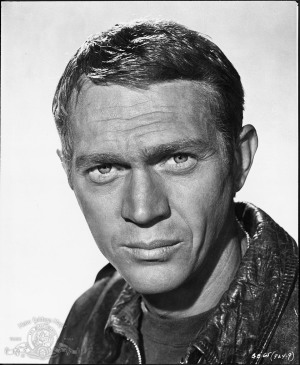
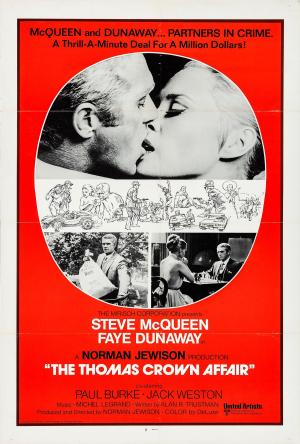
It is significant that the least cool film by Steve McQueen, King of Cool, is the one in which he strives hardest to be cool. Of course, effort is the antithesis of cool. I had expected to enjoy this film as a frothy 60s pop-artefact in the ARABESQUE vein, but it is tedious and gauchely unchic. Director Jewison has subsequently proven himself to be bereft of interest in his later career, but he confuses ripping off adventurous film-makers with being adventurous himself.
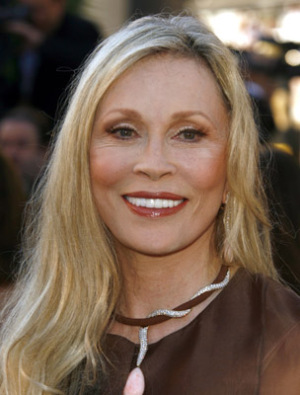
The film is NOT stylish, which is its claim to fame - its devices are irritating, its form is not aligned to an artistic point of view, the colour is ugly, the unravelling of plot is insultingly implausible, its use of stars is hopeless. Faye Dunaway, bristling with sexuality in BONNIE AND CLYDE, is an unloveable mannequin in this film, with an appalling taste in clothes. Steve McQueen, one of the great actors, is completely wrong for this film, lacking the necessary dark suavity of a Cary Grant. These characters are ciphers, without history, motivation or even charm: Thomas Crown plans a heist for kicks - at one point he hilariously suggests that he is fighting the 'system' - a $4 million capitalist dealing in property and currency!
The film tries amid the inept gloss to make some 'serious' points - capitalism is linked to crime and death; Crown, successful businessman, has a dark, split personality (lots of mirror/frame shots, hysterical laughing, split-screens). The use of this latter device is annoying and uninventive - unlike the complexity of Greenaway's THE PILLOW BOOK, in which multiple images disorient the viewer with unexpected juxtapositions and disruptions of time and space, the images here are all narratively coherent and hence redundant. The flashy direction is so satisfied with itself that it bungles the tension and excitement in not one, but TWO heist sequences, surely an expected skill in the 60s.
Compare this film to the amazing CHARADE, a genuinely stylish 60s film, which, while tongue-in-cheek, played its thrills straight; incorporated its stylistic and fashionable elements to visualise a growing desire between its two stars (Audrey Hepburn and Cary Grant were invented for this kind of film), who provide a genuine, touching, playful attraction, which evokes enormous audience goodwill, without resorting to gimmicks like the chess sequence, which is possibly meant to be funny, because it's certainly not erotic.
Although Jewison probably wanted to replicate the freshness and romance of an early Nouvelle Vague film, he has only succeeded in emulating that egotistical fraud Claud Lelouch. Like that purveyor of insipid, 'significant', romances, the only saving grace is the beautifully schmaltzy score, this one by Michel Legrand (although for real Legrand beauty, check out LES PARAPLUIES DE CHERBOURG).

 Enjoy unlimited movies and shows
 Download your favorite content to watch offline
 Simple interface & smooth performance




'%3e%3cpath%20id='Vector'%20d='M17.3996%2025.7999C17.3996%2025.9838%2017.3634%2026.1658%2017.293%2026.3357C17.2227%2026.5055%2017.1196%2026.6598%2016.9896%2026.7899C16.8596%2026.9199%2016.7052%2027.023%2016.5354%2027.0933C16.3655%2027.1637%2016.1835%2027.1999%2015.9996%2027.1999C15.8158%2027.1999%2015.6337%2027.1637%2015.4639%2027.0933C15.294%2027.023%2015.1397%2026.9199%2015.0097%2026.7899C14.8797%2026.6598%2014.7765%2026.5055%2014.7062%2026.3357C14.6358%2026.1658%2014.5996%2025.9838%2014.5996%2025.7999C14.5996%2025.4286%2014.7471%2025.0725%2015.0097%2024.81C15.2722%2024.5474%2015.6283%2024.3999%2015.9996%2024.3999C16.3709%2024.3999%2016.727%2024.5474%2016.9896%2024.81C17.2521%2025.0725%2017.3996%2025.4286%2017.3996%2025.7999Z'%20fill='white'/%3e%3cpath%20id='Union'%20fill-rule='evenodd'%20clip-rule='evenodd'%20d='M8.5%204H23.5C24.0523%204%2024.5%204.44772%2024.5%205V21.5H7.5V5C7.5%204.44772%207.94772%204%208.5%204ZM5.5%2022.5V5C5.5%203.34315%206.84315%202%208.5%202H23.5C25.1569%202%2026.5%203.34315%2026.5%205V22.5V27C26.5%2028.6569%2025.1569%2030%2023.5%2030H8.5C6.84315%2030%205.5%2028.6569%205.5%2027V22.5ZM24.5%2023.5V27C24.5%2027.5523%2024.0523%2028%2023.5%2028H8.5C7.94772%2028%207.5%2027.5523%207.5%2027V23.5H24.5Z'%20fill='white'/%3e%3cpath%20id='Union_2'%20fill-rule='evenodd'%20clip-rule='evenodd'%20d='M17%209C17%208.44772%2016.5523%208%2016%208C15.4477%208%2015%208.44772%2015%209V13.8258L13.1508%2012.2407C12.7315%2011.8813%2012.1002%2011.9299%2011.7408%2012.3492C11.3813%2012.7685%2011.4299%2013.3998%2011.8492%2013.7593L15.345%2016.7556C15.5205%2016.9079%2015.7495%2017%2016%2017C16.2506%2017%2016.4796%2016.9079%2016.6551%2016.7556L20.1508%2013.7593C20.5701%2013.3998%2020.6187%2012.7685%2020.2593%2012.3492C19.8999%2011.9299%2019.2686%2011.8813%2018.8492%2012.2407L17%2013.8258V9Z'%20fill='white'/%3e%3c/g%3e%3c/svg%3e)